
Unique Abilities portrayed in Children's Books

This week we read children's books that had characters with unique abilities. In A Boy Called Bat by Elana K. Arnold the main character has Autism, in Just Ask! Be different, Be Brave, Be You by Sonia Sotomayor each character that's introduced has a different disability. In this blog post I will be talking about how these books represent the disability community.

Summary:
A boy called Bat follows the story of Bixby Alexander Tam. Bixby is in the third grade and lives with his Mom and sister. Bat is very unique because he has autism and struggles with making friends. In the beginning of the book Bats mom brings home an orphaned skunk which is great because Bat is obsessed with all animals. The book follows Bat through his journey of learning to take care of the skunk as well as him dealing with the challenges of everyday life such as school and friends.

Summary:
Just Ask! Be different, Be Brave, Be You is the story about friends coming together to plant a garden. Within the first two pages a message of differences is already stated. First it's about the differences in flowers and how they all bloom together but at the same time being unique. On the second page the author talks about how all kids are different and if we're curious about them we should just ask them. As the story goes on each of the main characters, sonyia, friends bring in something new to plant in their garden. With each new kid that we meet through the book we are also introduced to the special ability that they have and how it makes them unique.
Personal Response:
These stories were all about celebrating diversity and I absolutely loved having the pleasure of reading them. In a boy called bat we could deter from the context clues that the main character has autism. It is not clearly stated in the text and I believe this is done so that the focus is not on the disability but rather who the character is as a person. A disability doesn't define somebody and Elana K. Arnold did an amazing job of making sure Bat’s disability doesn't define him. It was such a unique story and I loved that it was about a kid with autism. Too many times people with disabilities are not featured in books so its great to see a book centered around a character with a different ability. When reading Interrogating Depictions of Disability in Children’s Picture books by Monica C. Kleekamp and Angie Zapata I realized just how important it was to have inclusive children's literature that portrays a character with a disability. A lot of the time the literature that does portray a character with a disability the character is seen as a victim and the reader is made to pity them. Characters with disabilities are seen as less than others which can make people not know how to interact with someone who has a disability in real life. In school students with disabilities such as autism are looked down on. I think this is in part due to people just not knowing a lot about the disability and not feeling like they can ask the person or someone who knows the person about the disability. In Just Ask! The author showcases a variety of kids with a variety of disabilities. However, the focus of the story isn't centered around their disabilities but rather trying to educate the readers about the disabilities as well as trying to end the stigma of people with disabilities. On the second page of the book Sonia Sotomayor sends a message to the kids. She states that every kid is different and that if they are curious about another kid to just ask them about themselves. Going with the theme of the book Just Ask! I want to use this blog this week to educate you on a disability that I have become familiar with; autism. Autism affects everyone so differently and sometimes people don't feel comfortable asking the person about their disability or their loved ones who may be with them.
Autism is a developmental disorder that can cause significant social, communication and behavioral challenges. Autism can be diagnosed by a medical professional anytime between 18 months and 2 years. Students with autism are highly sensitive to things such as touch, noise, light, etc. and often time they do things to help them desensitize. These things are stims and oftentimes those stims can be frustrating to those around them. If a fire alarm suddenly goes off a student may drop to the floor and cover their ears. If they become overwhelmed they may start to flap their arms, rock back and forth, bouncing, rocking on their heels, etc. As Teachers it's important to be aware of the students with autism in our class so we know what might trigger their stims.
In school students with Autism may have a hard time communicating with their peers as well as their teachers. Some students on the spectrum may be non verbal and thus need other ways to communicate. This could be in the form of a digital communication system or a paper form which is called a vocabulary core board. Both of these things have a set of words that the student can put together to communicate. Students on the spectrum also have a hard time understanding their peers as they are not as in tune with sarcasm as well as identifying/understanding other people's emotions. These students often have a topic that they are extremely interested in and will talk to anyone and everyone about it. Talking about these enthusiasms is a way for them to break the social barrier and communicate with their peers.
How can we as Teachers help students on the spectrum?
Keep a schedule posted somewhere in the classroom as some students with autism like to keep a schedule.
If there is going to be a change to the daily schedule let the student know in advance
Have a designated space in the classroom where students can calm down if they get overwhelmed
Dont try and stop the student from doing a behavior that may be helping them to regulate themselves. (talk about dysregulation)
Try to connect lessons in the class to things the student is interested in
Use visual aids in the classroom
If you would like to do more research on your own I have included a section in the resources section of this blog with websites and other resources that give great information.
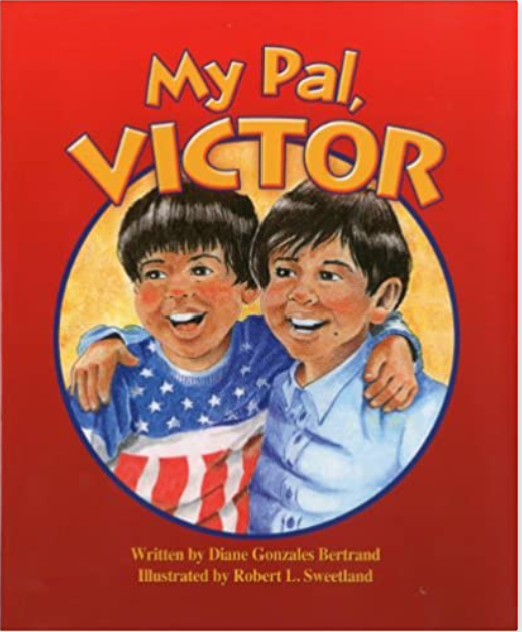
This week we were challenged with another task besides reading these two wonderful books. We were to explore books that have earned the Schneider Family Book Award as well as representing a disability experience. The book I chose for this is called My Pal, Victor by Diane Gonzales Bertrand and illustrated by Robert L. Sweetland. The story is about two boys who are the best of friends. It talks about all of the things they like about one another as well as things they like to do together. Not only are these characters part of the Latino community but one of them is actually in a wheelchair.
Throughout the book in the back of my mind I kept wondering what disability did this book portray because to me everything seemed pretty normal. I think that is exactly what the author wanted to happen. She didn't want the reader to focus on the disability but rather focus on the people without the disability. I feel as though when people are in public and they see someone with a visible disability they focus on what that disability is and how its affecting them rather than truly focusing on who that person is and what makes them unique besides the disability. When sharing this book with future students I feel that it is best to talk about how the author “hid” one of the character's disabilities. This can open up conversations about why students think the author chose to do this and what message they think the author is sending.
When researching the author and illustrator of this book I wasn't able to find much. What I did find is that Diane Gonzales Bertrand is a #ownvoices author as she is also about the Latino community. Although this book is not mainly about that community they are still represented in the illustrations. I could not find any information about the illustrator but I feel as though the author wanted to make sure that the illustrations represented that community. It shows that no matter what we look like or if we have a disability or not we're just like everyone else.
Questions:
Why do you think the author decided to not tell us one of the characters uses a wheelchair?
Victor has a dog that goes with him everywhere which is probably his service dog. Do you know what a service dog is? Have you ever met anyone with a service dog?
Do you think being in the wheelchair affects how Victor goes about his life?
Meet The Authors!

Elana K. Arnold is the author of A Boy Called Bat. Elana has written twelve books varying from picture books to young adult novels. In an interview with Sally J. Pla she talked about where she got the inspiration for the book A Boy called Bat. Her brother has always gone by his initials which spell ZAK. This lead her to think about what if someone went by their initials but instead the initials spelled BAT. She also based BAT's characteristics off of her own personality and how she acted as a kid and how she interacted with the world. Both of these things makes her and #ownvoices author because the characters personality characteristics are based off of her own characteristics and the main idea from the book came from her brother.

Charles Santoso is the illustrator of A Boy Named Bat. Charles always enjoyed drawing little things in his journal as a child which led him to become an illustrator. In this book all of the pictures are done in black and white. I think this allows the reader to really take in all of the emotions that BAT is feeling.
With this illustration you can feel just how excited BAT is about the baby skunk. He is an avid animal lover and now there's a baby skunk in his kitchen and he's both shocked and so excited.


Sonia Sotomayor is not only a #ownvoices author of Just Ask! but she is also an Associate Justice of the Supreme Court. Just Ask! is the first and only book she has written so far. While listening to an NPR interview I learned of her inspiration for writing this book. Years ago when she was giving herself an insulin shot in the bathroom another woman walked in. She didn't say anything to Sonia then but when she was leaving the restaurant she heard the woman made a comment about about how "She's a drug addict." Sonia was quick to explain to her that she is not a drug addict but a diabetic and that shot was insulin that helps keep her alive. Sonia wanted to write a children's book that not only talked about children like her but other children who have disabilities that people don't understand. " If you don't know why someone's doing something, just ask them." -Sonia Sotomayor

Rafael Lopez is an award-winning artist who did the illustrations for Just Ask! Lopez also has a #ownvoices perspective with this story because his son has autism. Having a son with autism has taught him so much about how children go through life with different abilities. You will notice that this book is very colorful and that's in part due to Lopez. To him bright colors represent diversity and emotion. In the beginning of the book the grass is dry and yellow but as more diverse characters are introduced there is more and more color introduced.


Comments